




What hardness testing tells you
Hardness testing is a central part of materials testing. It provides information on the strength, load-bearing capacity and wear resistance of a material. Whether metal, plastic or rubber: hardness is a decisive parameter for the quality, safety and service life of components.
Which method is suitable depends on the material, the component size and the test location:
| Method | Typical application | Our equipment |
|---|---|---|
| Rockwell (HRC, HRB, HRA …) | Hardened steels, series testing | Stationary hardness testing machines, Equotip Portable Rockwell |
| Brinell (HBW) | Castings, soft and inhomogeneous materials | Stationary hardness testing machines |
| Vickers (HV) | Thin layers, small test surfaces, laboratory | Stationary hardness testing machines |
| Leeb (HLD, HLG) | Large, heavy components on site | Portable hardness testers |
| UCI | Fine-grained materials, welds, on site | Portable hardness testers |
| Shore (A, D) | Rubber, elastomers, plastics | Shore hardness tester |
Our products for hardness testing
- Hardness reference blocks
- For calibrating and daily checking of your hardness testers, DAkkS-calibrated
- Portable hardness testers
- Measurement directly on the workpiece when it cannot be transported
- Stationary hardness testing machines
- New from Mitutoyo, refurbished or modernised
- Shore hardness testers
- Fast, reproducible readings on rubber and plastics
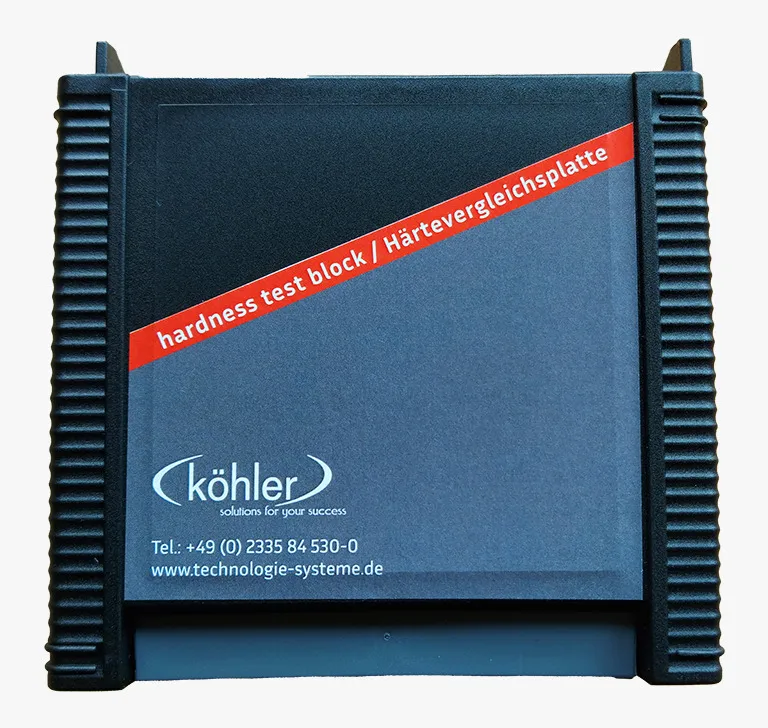
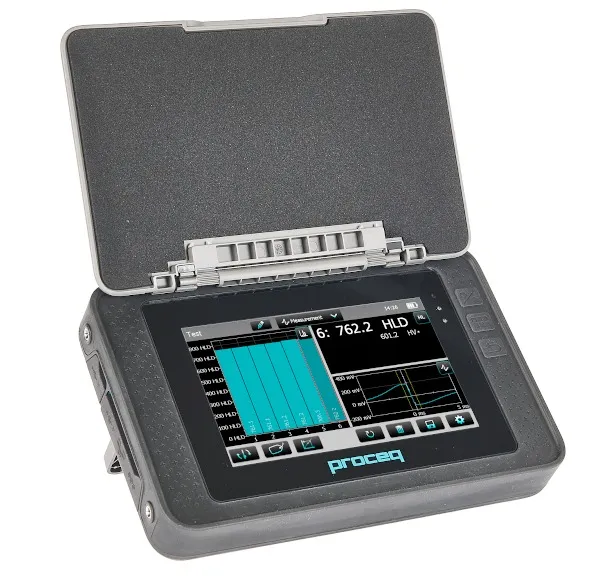
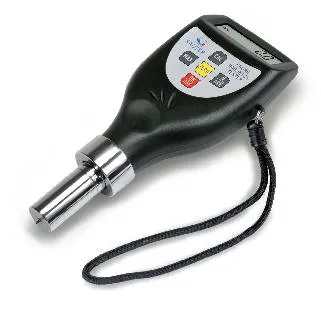
Hardness reference blocks Portable hardness testing Shore durometer
Would you like to train your staff? In the seminar “Hardness Testing in Theory and Practice” your employees learn about methods, standards and typical sources of error.